African-American Landmarks

Places that are important in Black History and the Civil Rights Movement in the United States.

The memorial commemorates the service of 209,145 African-American soldiers and sailors who fought for the Union in the American Civil War.
No Image Available
Opened in January of 1999, the Civil War Memorial Museum uses photographs, documents and state of the art audio visual equipment to help visitors understand the African American's heroic and largely unknown struggle for freedom.
No Image Available
Built in 1976 for the nation's Bicentennial, the African American Museum in Philadelphia was the first institution funded and built by a major city to preserve, interpret and exhibit the heritage of African Americans.
No Image Available
Founded in 1978 by Dan Moore, the African American Panoramic Experience Museum (APEX) seeks to educate people about the depth and breadth of the African American experience and celebrates its unsung heroes.
No Image Available
Also know as the First African Baptist Church, this Beacon Hill landmark is the oldest black church building in the United States. The building was dedicated on December 6, 1806.
No Image Available
This African-American Cultural Center is a part of Louisiana State University and is located in the former Christian Science building. The center was founded in 1972. It opened at its current location on on January 17, 1993.
No Image Available
The African-American Research Library and Cultural Center is a general-service library, as well as a research facility and cultural center containing more than 75,000 books and related materials that focus on the experiences of people of African descent.
America's Black Holocaust Museum in Milwaukee, Wisconsin, is a unique museum dedicated to the history of African American enslavement in the United States.
The museum is the only memorial dedicated specifically to the victims of the enslavement of Africans in the United States.
Back of the Baltimore Civil War Museum, 2008
Originally the President Street Station, this site and the rail line were key elements of the "underground railroad" by which many slaves escaped to the north before the Civil War.
Bethel Baptist Church in 1993
The Bethel Baptist Church, Parsonage, and Guardhouse are associated with the first organized movement of the modern civil rights movement. The Alabama Christian Movement for Human Rights was headquartered here from 1956-1961.
The 16th Street Baptist Church section of the Milestone exhibition gallery in the Birmingham Civil Rights Institute
Opened in November of 1992, Birmingham Civil Rights Institute is a large interpretive museum and research center that depicts the struggles of the American Civil Rights Movement in the 1950s and 1960s.
No Image Available
Started in 1971 by a Denver barber, the Museum contains a remarkable collection of items used by black pioneers in the West. It is housed in the former home of Justina Ford, the first licensed black woman doctor in Colorado.
Brown Chapel African Methodist Episcopal Church, taken in 2000.
This church was a starting point for the Selma to Montgomery marches in 1965 and played a major role in the events that led to the adoption of the Voting Rights Act of 1965.
No Image Available
Although it has had different names, Florida Agricultural and Mechanical University was founded in 1887, and in 1891, it was designated Florida's land-grant institution for African-Americans.
Foster Auditorium on the campus of the University of Alabama.
This multi-purpose facility was built in 1939 and is most famous as the site of of the "stand in the schoolhouse door" incident. On June 11, 1963, Governor George C. Wallace blocked the entrance to prevent registration of African Americans.
This is the home of one of the most famous African Americans in United States history. Perched high on a hilltop, the site offers a sweeping view of the U.S. Capitol and the Washington D.C. skyline.
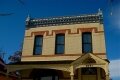
The Webster Telephone Exchange Building, the home of the Great Plains Black History Museum.
The museum is located in the Webster Telephone Exchange Building, which is on the National Register of Historic Places.
No Image Available
John G. Riley was born a slave and died a millionaire. His home in Tallahassee has been turned into a museum dedicated to African-American history and culture. It is one of two original homes in an area that was once a middle-class black neighborhood.
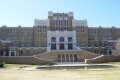
The Reflecting Pool was restored during the 2004-05 school year.
In 1957, nine African-American students, known as the Little Rock Nine, were denied entrance to the school in defiance of the 1954 U.S. Supreme Court ruling ordering integration of public schools.
The main (southern) entrance to the National Underground Railroad Freedom Center.
Using the theme of the Underground Railroad, the Center attempts to inform people of the issues important to Freedom in the past, present and the future. The hope is that everyone will use their voice to promote Freedom for all.