Forgot your Password?
New Member Registration
Visit our sister site:
Landmark: Earth
Pennsylvania Tourist attractions, famous Pennsylvania landmarks and other Pennsylvania points of interest.
|
Opened in 1857, the building is the oldest grand opera house in America used for its original purpose. It is the home of the Pennsylvania Ballet and the Philadelphia Opera Company.
|
|
Built in 1976 for the nation's Bicentennial, the African American Museum in Philadelphia was the first institution funded and built by a major city to preserve, interpret and exhibit the heritage of African Americans.
|
|
The Allegheny Portage Railroad was the first railroad constructed through the Allegheny Mountains in central Pennsylvania. It was approximately 36 miles (58 km) long, and operated from 1834 to 1854.
|
|
Designed by John Haviland, the Greek-Revival style building was the original home to the Franklin Institute, which opened for students in 1826. It has been the city's history museum since 1938.
|
|
The Awbury Arboretum was established in 1916 by the family of Henry Cope, a Quaker shipping merchant. The grounds were partially designed by William Saunders, designer of the Cemetery at the Gettysburg Battlefield and of the U.S. Capitol grounds.
|
|
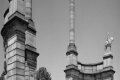
The Benjamin Franklin Bridge, originally named the Delaware River Bridge, is a suspension bridge across the Delaware River connecting Philadelphia, Pennsylvania and Camden, New Jersey.
|
|
This sculpture by Joe Brown was presented to the city of Philadelphia by the Pennsylvania Free Masons whose temple is across the street. The artwork was dedicated on June 27, 1981.
|
|
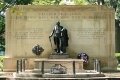
Located in the the Franklin Institute Science Museum, the National Memorial features a 20 feet (6m) tall statue of Benjamin Franklin sculpted by James Earle Fraser between 1906 and 1911.
|
|
The only synagogue ever designed by famed architect, Frank Lloyd Wright, Beth Sholom is Hebrew for House of Peace. Its steeply inclined walls of translucent wire glass and plastic are meant to represent both a mountain and a tent.
|
|
The Betsy Ross House is generally recognized as the place where Betsy Ross lived when she may have made the first American Flag. The building was built around 1740 and is presented as it would have looked when Betsy Ross lived and worked there.
|
|
This stainless steel silhouetted bust of Benjamin Franklin has porticos resembling keys and supporting blue arches mounting crests resembling kites. Four additional columns support abstract lightning bolts.
|
|
The Battle of Bushy Run was a major victory for the British during Pontiac's Rebellion and enabled them to secure their control of the Ohio River Valley and what was to become the Northwest Territory.
|
|
Build in 1770 and owned by oldest trade guild in America, Carpenter's Hall was the site of the First Continental Congress in 1774. Today it is part of Independence National Historical Park.
|
|
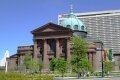
The cathedral was dedicated on November 20, 1864 by James Frederick Wood, the first Archbishop of Philadelphia. It is modeled after the Lombard Church of St. Charles (San Carlo al Corso) in Rome and is of the Roman-Corinthian style of architecture.
|
|
The community is regarded as one of the best-preserved examples of the Garden City concept by city planners, architects, and landscape architects. It is also a National Historic Landmark and a City of Pittsburgh historic district.
|
|
Chinatown functions as a popular tourist destination, a center of trade, and as a home to many of the city's finest ethnic restaurants and bakeries. It is the fourth-largest Chinatown in the United States.
|
|
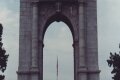
The Friendship Arch is an ornate paifang, a gate or archway used to divide regions of a city. Though many North American Chinatowns have these arches, Philadelphia's version is considered to be more elaborate than most.
|
|
Constructed between 1727 and 1744, Christ Church is the birthplace of the American Episcopal Church in the United States. The congregation included 15 signers of the Declaration of Independence.
|
|
Home to the Philadelphia Phillies, Citizens Bank Park is a 43,647-seat baseball-only stadium that opened on April 3, 2004. The ballpark was built to replace Veterans Stadium.
|
|
The Curtis Publishing Company, founded in 1821 became one of the largest and most influential publishers in the United States during the early 20th century. This building, the company's headquarters, is an example of Georgian Revival architecture.
|
© 2007 - 2012 Robert J. Moran