Notable Architecture
Buildings and other man-made structures that are noteworthy due to the style or innovation of their design.
|
40 Wall Street is a 70-story skyscraper originally known as The Bank of the Manhattan Company building. It was completed in 1930 after only 11 months of construction, and was the tallest building in the world for less than 2 months.
|
|
The bridge's construction was authorized by Congress on February 24, 1925 and formally opened on January 16, 1932. Designed by architectural firm McKim, Mead and White, the neo-classical bridge is 2,163 feet (660 m) long.

|
|
Built in 1926, the Aztec Theater is a exotic-themed movie palace. It is decorated with vibrantly-colored columns, sculptures, furnishings and murals, many of which are authentic reproductions of Meso-American artifacts.
|
|
The 13 room cottage was built by Samuel Taylor Suit, the manufacturer of a popular whiskey. Begun in 1885, the "castle" became the local venue for galas and other events of the social elite.
|
|
The only synagogue ever designed by famed architect, Frank Lloyd Wright, Beth Sholom is Hebrew for House of Peace. Its steeply inclined walls of translucent wire glass and plastic are meant to represent both a mountain and a tent.
|
|
Built between 1888 and 1895 for George Washington Vanderbilt II, this French Renaissance-inspired chateau is the largest privately-owned home in the United States at 175,000 square feet.
|
|
This ornate Victorian house has been listed by the Library of Congress as one of the fourteen most representative Victorian structures in the nation. The Roman Catholic Diocese of Galveston owns the house and offers tours.
|
|
Standing at 1,047 feet high (319 m), the Chrysler Building was briefly the world's tallest building before it was surpassed by the Empire State Building in 1931. It is still the world's tallest brick building.

|
|
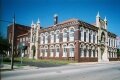
El Centro Espanol was a organization of cigar workers in Ybor City and West Tampa. Build in 1912, members could use the building as a sort of club house or for amenities such as a gym, casino (game room), cafe, etc.
|
|
It stood as the world's tallest building for more than forty years, from its completion in 1931 until the construction of the World Trade Center North Tower in 1972. It is now once again the tallest building in New York.
|
|
This church was built in the Gothic Revival style in 1859. It is noted as one of the most pristine examples of Ecclesiological Gothic architecture in the South. It is also one of the least-altered structures by architect Frank Wills.
|
|
One of Frank Lloyd Wright's most famous buildings, Falling Water is a home build over a waterfall. Long horizontal and vertical lines and overhangs were features of Wright's style.
|
|
Home of the American archeologist and tile maker Henry Chapman Mercer, Fonthill was Built between 1908 and 1912. It is an early example of poured-in-place concrete and features 42 rooms, 200 windows, 18 fireplaces and 10 bathrooms.
|
|
The Central Branch of the Free Library is one of two buildings that are replicas of those in the Place de la Concorde in Paris. This was done in part to help establish the Benjamin Franklin Parkway as Philadelphia's Champ Elysees.
|
|
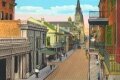
The French Quarter is the oldest and most famous neighborhood in New Orleans, Louisiana. Many of the buildings date from before New Orleans became part of the United States. New Orleans Mardi Gras celebration is centered here.
|
|
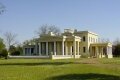
Gaineswood is one of the most significant remaining examples of Greek Revival architecture in Alabama. The house and grounds are currently operated by the Alabama Historical Commission as a historic house museum.
|
|
Built for one of the owners of the Proctor and Gamble Company, the house is a notable example of the Arts and Crafts style of architecture. It played the part of Dr. Emmett Brown's home in the movie "Back To The Future."
|
|
Government Street Presbyterian Church is one of the oldest Greek Revival church buildings in the United States. The interior is notable because the original Greek Revival design is fully intact with very little alteration.
|
|
It is the only surviving residential example of Richard Upjohn's Italian villa style that was especially designed to suit the Southern climate and the plantation lifestyle. The building was designed and constructed for Edward Kenworthy Carlisle.
|
|
Upon its completion in 1834, the building became the financial center for Philadelphia, housing commercial houses, marine insurance companies, the Philadelphia Board of Trade, and the Philadelphia Stock Exchange.
|